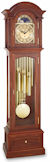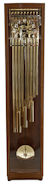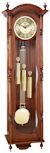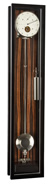
Grandfather & Grandmother Clocks - Hand-crafted to Perfection.
Sehen sie Oakside Klassische Uhren in Deutsch...
Grandfather Clocks, Grandmother Clocks and Vienna Regulators. Oakside Classic Clocks specialize in hand crafting new Grandfather Clocks, Grandmother Clocks and Vienna Regulators. We build clocks to our original designs and as re-creations of the classic masterpieces of centuries past. We proudly continue to build longcase clocks in the tradition that has existed for some four hundred years. Our clocks are individually built to the highest standards and we are confident that the quality is unsurpassed by any other maker.
All of the Longcase clocks displayed on these pages have been designed and built by Frank & Barbara Redmile in their workshop at Oakside Classic Clocks, Pamber Heath, Tadley, Hampshire, England, in the United Kingdom (UK). Our philosophy is Quality First, each of our clocks is hand-crafted to perfection and fine tuned in our showroom prior to delivery. Setting such high standards means that we are only able to build a very limited number of Grandfather Clocks, Grandmother Clocks and Vienna Regulators each year, consequently, a clock purchased from Oakside will remain very exclusive and like the Masterpieces of the very early years of Longcase Clock Making - we are confident that your new Oakside creation will become an 'Antique of the Future'.
We design and build to the highest specification, using the best of traditional and modern techniques. All of our longcase-clock cabinets are constructed with the Kiln dried solid hardwood - To ensure that we are environmentally friendly, the timber we use in the construction of our clocks is certified with Chain of Custody certification to the FSC or PEFC standards. To compliment our cabinet making, we install very high quality movements and pendulums; Kieninger® - the oldest existing manufacturer of mechanical movements in the world - supplies these items. Our dials are custom made in solid brass by Bedford Dials Ltd of Tenbury Wells.
When you place an order we will ask you to personalize your chosen design by specifying your preferences, selected from the relevant 'Options & Prices Calculator' page. If you are unable to visit our showroom we will be pleased to send you wood samples, to assist in you selection.
When you place an order we require a deposit of £200 - this guarantees the delivery price irrespective of the delivery period! Distance permitting, Frank and Barbara will
personally deliver and install
your clock, however, the quoted price includes packaging,
insurance and delivery to all mainland UK addresses. We have delivered clocks
to customers in most European countries, the USA and to Australia & New
Zealand – please do not hesitate in enquiring about export
sales to any part of the World.
This web site is our shop window to the World - we endeavor to ensure that
the photographs and the detailed specifications contained, provide comprehensive
information about our clocks but you are invited to phone or e-mail if you have
any queries! We invite to you make a personal inspection, by visiting our
showroom where we have examples of most of our clocks on display! - We are very
informal, but please phone Frank and Barbara to arrange a viewing appointment.
New Longcase Clock or an Antique?
Nearly all of our customers have stated, that they had previously spent time looking for an Antique Longcase Clock - what they had discovered is that any clock over fifty years old is commonly described, by the vendor, as an antique, instead of just Old! They had also found it difficult to ascertain the real value of any particular clock! This brings us to the following questions - what is a genuine antique, how do you ascertain its quality, what is its real value, what will it cost to maintain and will it keep good time?
The Longcase clock in its earliest form evolved from the Lantern clocks, these had verge escapements and it's action required the pendulum to describe a very wide swing - to wide to realistically enclose within a case - these clocks often had only an Hour hand as time-keeping was relatively poor. The invention of the Anchor Escapement which propels a pendulum through a very narrow swing, improved time-keeping and enabled the enclosure of the pendulum and the weights within a longcase cabinet - this also overcome the problem of people, pets and draughts affecting the motion of the exposed pendulum.
The longcase clocks of the period 1670 - 1740 generally had square dials and often had cabinets adorned with Marqueterie, many had movements that required winding every 30 hours. The Arch dial appeared about 1700 and rapidly become the 'must have, feature of the day - eight-day movements had also become the norm! The invention of the Dead Beat Escapement by George Graham FRS in 1715 and the Temperature Compensating Pendulum by John Harrison of Pontefract in 1729, together, very dramatically improved the ability of longcase clocks to provide accurate and consistent time-keeping! Until the 1750's the dominating influence of the Clockmakers Company also ensured that all longcase clock Makers worked to very high standards and the clocks that have survived from that period now command very high prices.
Clocks built after the demise of the influence of the Clockmakers Company (Guild) vary considerably in construction,
quality and in purity of style, often bringing together an amalgamation of features and styles from different centuries - although highly skilled Makers continued to create very high quality clocks, anybody with woodworking skills could now build a clock - many
later clocks were built by village or town carpenters, men skilled at building barns
and coffins but lacking the design flair for building fine pieces of furniture,
consequently, antique clocks vary considerably in style, quality and in their
ability to keep good time! The introduction of mass produced clocks around 1900 also furthered the decline
in quality.
Other things to consider! The vast majority of antique clocks were built for very large houses, consequently, if they are still in their original form they will be far too tall for modern homes; through the centuries, most have been the subject of alteration to follow later trends in styling, many have been cut down in height to fit smaller houses and almost all have been prone to infestation through lack of timber treatment and to attacks of dry rot after standing on damp solid floors. Regarding the movements - these can be very reliable - a periodic clean of the wheels and pinions and lubricating the pivots should provide reasonable service but damaged or broken parts will have to be custom made!
The final decision between a new 'High Quality' hand-crafted Longcase clock or an Antique will depend very much on personal preferences and perhaps your budget but unless your home has very large rooms with high ceilings, the height of an original antique clock may well be the deciding factor! All of the floor clocks in the Oakside range, apart from the York Grandfather Clock, have been deliberately designed to fit the lower ceilings of modern homes - To keep your clock in perspective with its setting, we recommend a minimum distance of 12 inches between the top of the clock and the ceiling and that the center of the dial should be approximately level or slightly higher than your eye-line.
OUR MONEY BACK PROMISE.
We will refund the full purchase price of the delivered clock if it's quality
fails to match your expectations.
For further details please read our Terms and Conditions.
Oakside Classic Clocks:
Tel: 0118 9701 377 | Fax: 0118 9701 506
© Oakside Classic Clocks