Clocks Made by Hobby Woodworkers - "Our friends world-wide".
A Gallery of clocks made by hobbyist woodworkers using a Kieninger Movement, Dial & Pendulum Set purchased from our range. If you like to share information about the clock you've built and have it published on this web page, please follow these guidelines:
- We like a few high resolution pictures in JPEG format.
- A description of the clock such as type of wood, height, width, depth, finish, and an indication of the time it took you to complete the clock.
- Please specify which movement, dial, pendulum set you installed
- Anything interesting you like to share about the project.
- Contact Oakside to inform Frank of you intention and he will give you instructions how to mail or email the pictures and text to him.
- We would like to publish your first and last name and your Country, we will not publish your email address. A link to your web site is only considered if it is of a non-commercial nature and has to do with you clock building.
- Oakside reserves the right to decline a request for publication and the right to edit the supplied material.
Click on a picture to see a larger picture and use the browser's back button to return to this page.
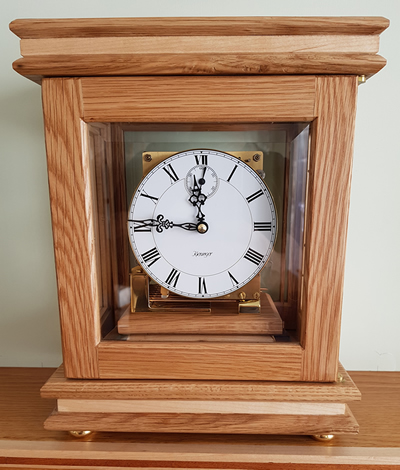
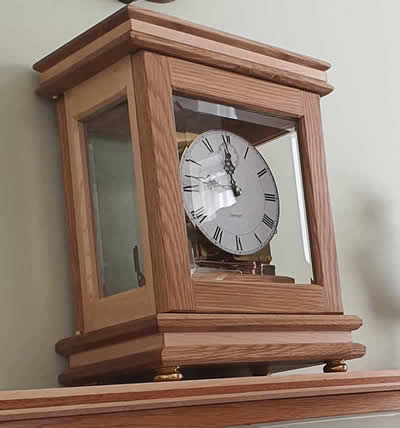
A table clock in white oak and maple fitted with the Kieninger J 0203 Rear Winding Movement
Alan Smith - Weoley Castle - Birmingham
Hi Frank
Please see attached photos of my first clock build using one of your Kieninger 03RS clock makers set.
The case is made of white oak and maple which is all jointed using stub mortice and tenon joints , the movement is mounted on a white oak and maple plinth and the bevelled glass is fitted with internal beads and brass pins.
Thank you for the wonderful movement which arrived working perfectly.
Kind regards
Alan Smith
|
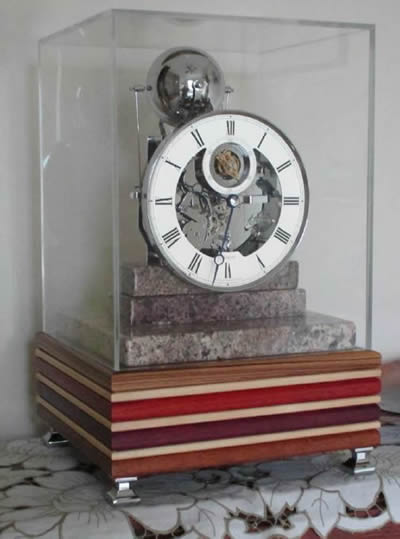
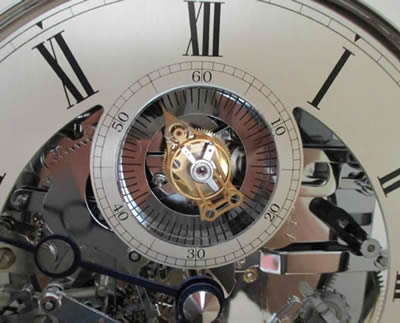
Modern mantle clock with the Kieninger RTU tourbillon escapement movement.
Karl Stone - Medina - Ohio - USA
Frank
Here´s what I did with the Kieninger RTU chrome movement that Oakside Classic Clocks you supplied.
I figured since the movement is so fancy, the case should be minimalist.
Exotic wood base: From bottom, merbau, maple, purpleheart, maple, padauk, maple, zebrawood.
Three-piece granite pedestal:
That was a real education working unsuccessfully with several local kitchen countertop fabricators, before finding one that had a computer-controlled water jet and was willing to use it for a piker who had the guts to walk in with small pieces! The display box is acrylic. I shouldn´t tell you what the feet are, but I´m unafraid to announce proudly that they are contemporary, square, chrome, drawer pulls!
Thanks for your help getting the movement.
Karl
Karl Stone
|
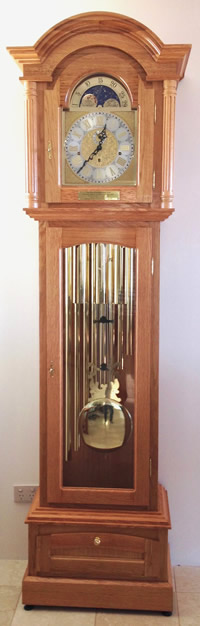
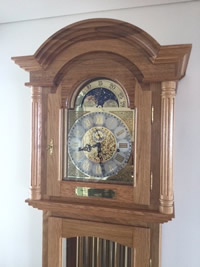
Grandfather clock courtesy of Dempsey Woodworking Canada
Neil Aitkenhead - Queensland - Australia
After several pieces of furniture made in American White Oak, i.e., Dining table, TV cabinet, Large painting and mirror frames, book case, I decided my next woodwork challenge was a Grandfather Clock. I have a history of wood related projects over many years, Yachts, Houseboat, the big one a Falco F.8L aircraft which I have been flying now for 16 years. Then a caravan, and more recently a North American style 15 foot Cedar strip plank Canoe.
The plans for the Clock were courtesy of Dempsey Woodworking from USA which were very well detailed. It is finished in a 2 pack satin clear. Designed for the German Kieninger HTU06 movement.
We chose the Roman figured dial as we think it more fitting for the design. It has now been installed in our apartment since September 2021 and after some adjustment it is keeping very accurate time and the chimes and hour strikes are all working well. It requires the weights winding back up every 7 days with a small reserve.
Many thanks to Frank of Classic Clocks for his assistance and information in the selection of the movement and for the shipping process half way around the globe to us in Australia.
Neil Aitkenhead
Neil Aitkenhead
|
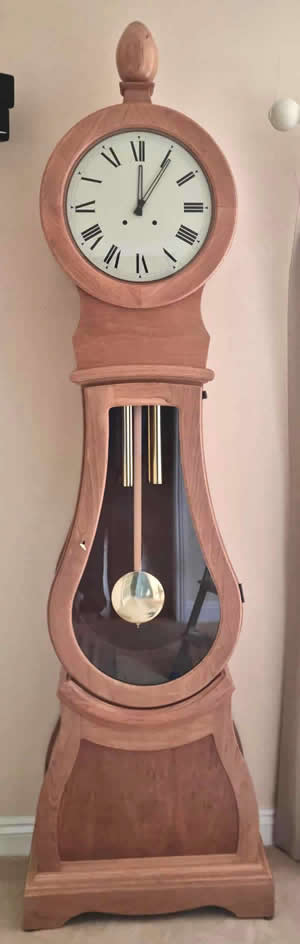
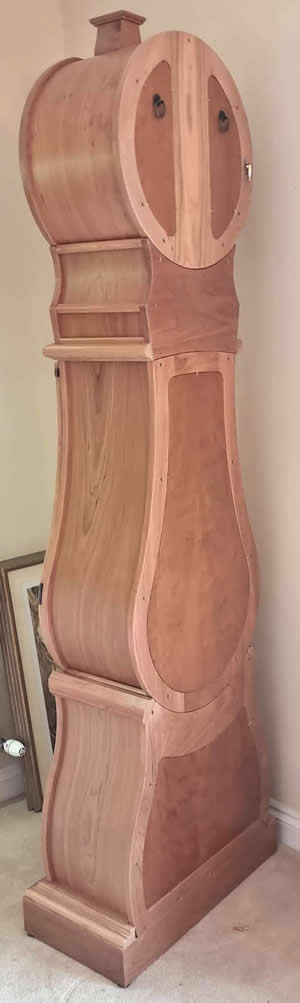
Superb Mora Floor Clock in Cherry.
Steve Coggins - Farnham - England
Featuring the Kieninger HS 116cm Comtoise movement set
Steve Coggins
|
Modern Floor Clock
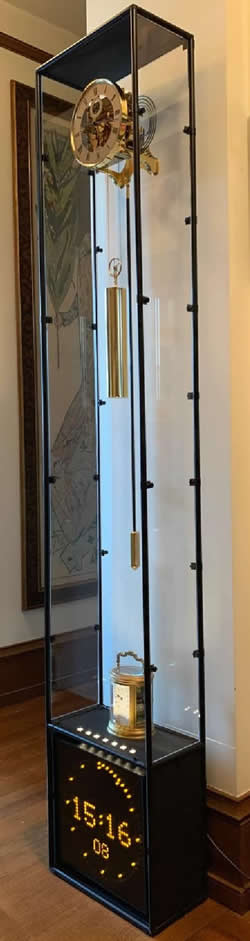
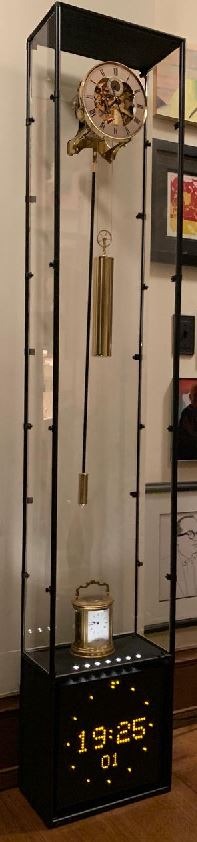
Gerald Luss - New York - USA
Waiting for text
Gerld Luss
|
Grandfather clock made by Roy Breakwell
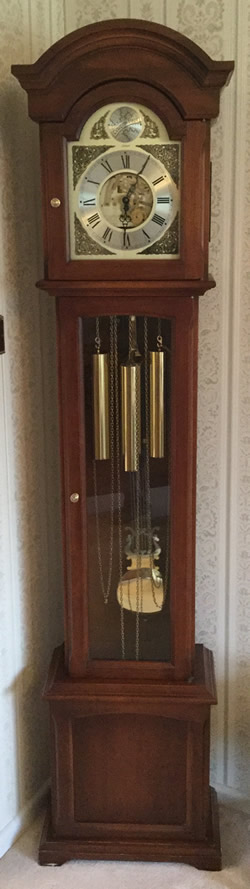
Roy Breakwell -Bognor Regis - England
Hi Frank. The old/new SK100 movement you’re supplied approx 2 months is “ticking & chiming ” perfectly however I have made some modifications to the clock (not movement) which I would like share with you: 1. I’ve cut a round hole in the clock face to expose the ‘clock workings’ which is of more interest to me that the original gold foil. I’ve attached 2pics & although I appreciate that it may not meet universal approval, I much prefer to see the clock movement operating.
2. By adding extra chains I’ve extended the clock operating time from less than 4 days to over 8 days.
All the Best from Roy Breakwell
Roy Breakwell
|
Grandfather clock made from Zebrano
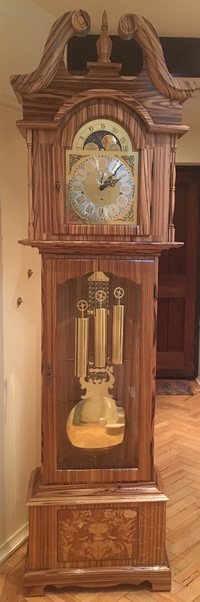
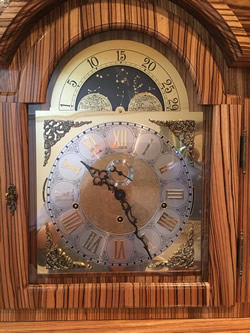
Graham Hindley – Epsom - Surrey - UK
My Grandfather clock is based on a design called The Sir John A. Macdonald. I used plans I bought from a Canadian company but adjusted those plans to make sure the finished clock could accommodate the swing of the pendulum using the Kieninger KSU50 movement.
The Grandfather clock is made from Zebrano or Zebrawood veneer and solid wood.
The marquetry on base of the clock has a background European Walnut, the black banding is dyed Poplar, the yellow marquetry is Boxwood, the golden yellow is Satinwood, red brown is Brazilian Mahogany, the white is Sycamore and the dark brown is Rosewood. On the front panel the butterfly is Burr Maple.
Behind the Pendulum is an Zebrano veneered panel with a Rosewood and Maple cross inserted into the veneer.
Graham Hindley
|
Mantle clock in Western Australian Jarrah.
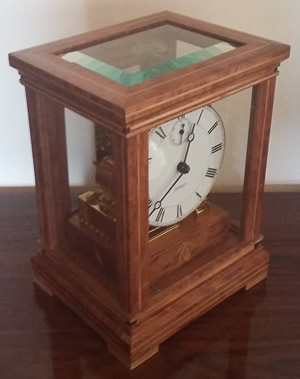
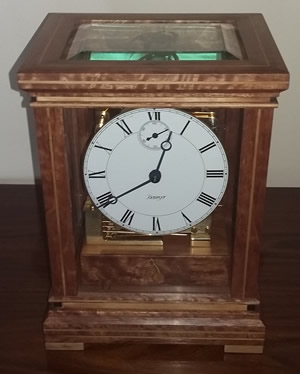
Mike Trefry - Floreat - Perth - Western Australia
The Quandong clock
The case is made from Western Australian Jarrah. It is from a plains jarrah tree that has grown in a sandy open environment, rather than its more typical forest environment, hence its lighter colour. The stringing is quandong, as are the feet, the key drawer, and the inlays on the movement
plinth. It is a rear wound movement with key kept in a drawer accessible
through the rear door. The bevelled top glass has been engraved with a
typical quandong leaves and fruit motif. All the glass is held in with
small glazing strips attached to the case with small brass pins. The case houses a Kieninger, triple chime JE movement.
Mike Trefry
|
Superb Floor Clock
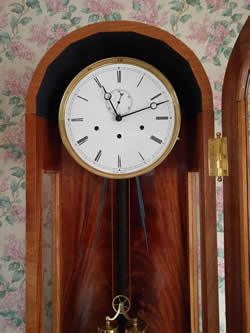
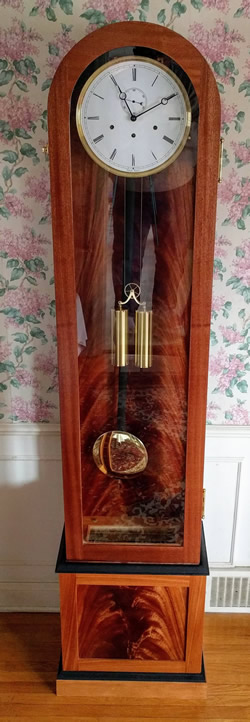
Steve Prescott - Minneapolis -Minnesota-USA
Dear Frank,
Sending you some pictures but before I get on to that I must say that your website betrays an orderly mind. One expects the features that you include from the big companies such as Dell Computer but here you offer all of that for the tiny clock buyer´s market. Quite impressive. And then you manufacture clocks, deliver personally, field questions, maintain inventory, program your website (I assume) and on and on. Do you sleep at all?
On to the clock:
Height: 75 inches (1,905 mm); Width at base: 19 inches (482 mm); Depth at base 9 inches (228 mm). I used Sapele (African Mahogony) lumber and veneer. The project took roughly 11 weeks (from Jan. 10 to March 22). The internals are of your clockmakers set #46 (Kieninger RWS 25 116 cm) with the larger 270 mm dial. Glass: double-strength (1/8 inch). Finish: High gloss poly on the veneer, medium gloss everywhere else.
Of note, I was perplexed over how to make the curved hood until I saw a picture of an antique clock on the internet where the hood was built in the manner of a barrel with staves. With plenty of glue biscuits and 7/8 inch stock, the unit turned out to be quite sturdy. It rests on dowels and can be easily removed. Another problem was how to ebonize the pendulum arm and molding. The solution (thanks to Les Casteel of the Missouri Woodturners Association) was India ink on bare wood. It was quick and easy and turned out perfectly. On the veneer, I took the leap into the unknown because I wanted crotch mahogany. It was challenging (I put my right arm out of commission for several days from working the clamps) but not so much that I would discourage anyone from trying.
Now that it´s over I think I could probably make the same clock case in close to half the time and do a better job to boot. Even though this is a gift to my wife, I take pleasure in it as well. I grew up with a grandfather´s clock in our home and it´s good to hear the chimes once again. Thanks for doing your part in all of this.
Steve Prescott
|
Small mantle clock in Walnut
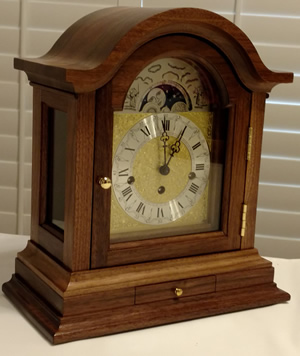
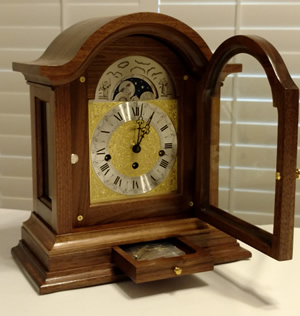
Robert Gilmore - Anaheim - California - USA
Small mantle clock in Walnut.
Finished with satin polyurethane.
Incorporating the Oakside AEL Set 01 and the Kieninger 143mm x 197mm Special moon phase Dial with black painted Roman numerals.
Bob Gilmore
|
Simple Farm House Bracket Clock circa 18th century.
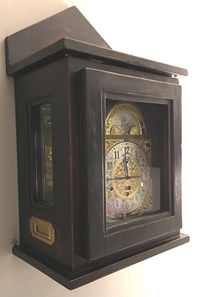
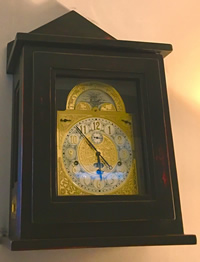
Tim Miser - Oklahoma - USA
Thanks Frank.
I have attached photos of the clock I recently finished. It’s built around Kieninger’s RWU-3, which as you know is their 9-bell, pendulum mantel movement. I was fortunate to purchase the last unit from you, and understand they are no longer in production.
This was a beginning woodworking project for me, so I had a lot to learn. Fortunately my aesthetic was one of clean lines and simple construction, something that might have been found in a little farmhouse a couple centuries ago.
Construction was using poplar, since I knew I would be painting the finished piece. All joinery was dowel. Patterned after a writing desk I once owned, I first painted all wood burgundy. I followed this with matte black and distressed select areas to reveal the undercoat. I then finished with a hand-rubbed wax and am rather happy with the result. In the end it looks like a piece that has been knocked around for many years; it has built-in age.
Thanks again for your great service and helpful tips. Best of luck from Oklahoma.
Tim Miser
|
Superb Bracket Clock
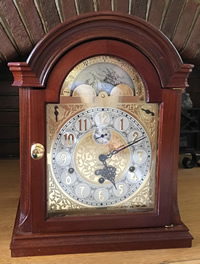
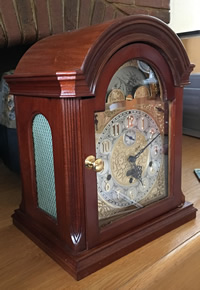
Anthony Martin - Bexleyheath - Kent - England.
Waiting for details.
Anthony Martin
|
Wall clock to William´s design.
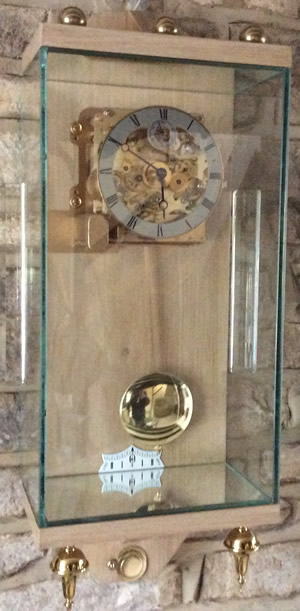
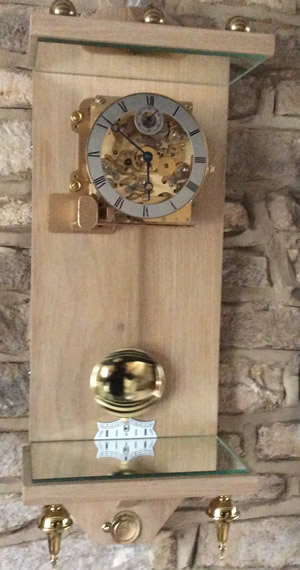
William Field - Ferndown - Dorset - England
Wall clock to William´s design and fitted with the Oakside Set 06 featuring the Kieninger JP 1210 movement.
William Ford
|
Waiting on details
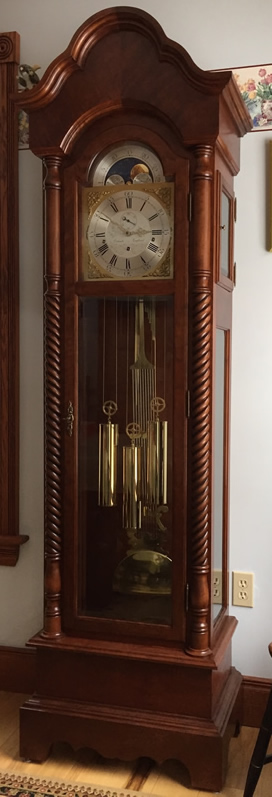
Brad Lanzer - Durham - New Hampshire - USA.
Waiting for description.
Brad Lanzer
|
A fine wall clock in Oak.
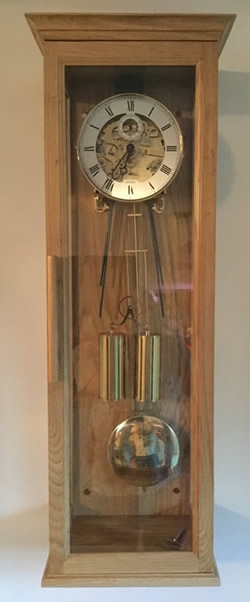
Stephen Pardoe - Chippenham - Wiltshire - England
Made by my father and brother, for family members, using Kieninger Movement Sets supplied by Oakside.
Stephen Pardoe
|
A cottage style floor clock in Oak.
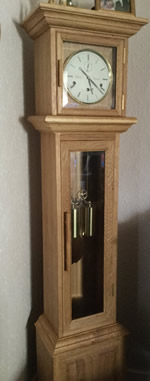
Stephen Pardoe - Chippenham - Wiltshire - England
Made by my father and brother, for family members, using Kieninger Movement Sets supplied by Oakside.
Stephen Pardoe
|
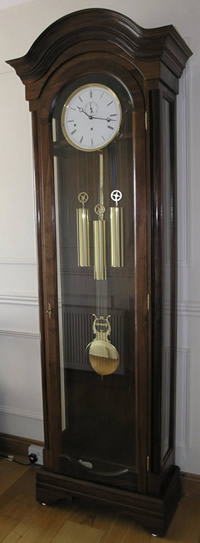
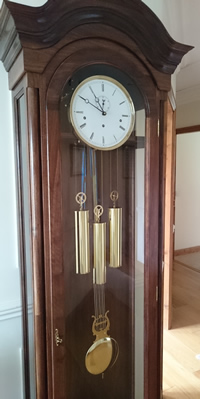
French Style Floor Clock
Ian Hodges - Bunclody - Enniscorthy - Co Wexford - Ireland
Hi Frank,
Happy to report I´ve finished my clock and am delighted with it. Many thanks indeed for your advice which I was very pleased to follow. The vhb tape was wonderful and allayed all my concerns over the joints on the door. I wanted to use laminated glass but that only came in 6mm and I didn´t want to risk the weight. I used 4mm toughened instead and that was still a quite heavy, but using the tape helped no end. I followed your suggestion to connect the gong rods directly to the back panel rather than make a sounding board. I had always intended to make the back panel thicker after seeing what had been done on some antique models. Your suggestion looks good and the sound is terrific.
The most trouble I had was with bending the ply for the top panel. I had hoped to laminate this but I had very poor results with my attempts at gluing veneer. Some practice needed there. I eventually bent some 4mm walnut faced ply over a jig whilst steaming it from below. I thought the crown moulding would be challenging but it was quite straightforward in the end. I made it in three three quarter inch layers, and cut the mitres on a custom made jig.
I´m very happy with the colour and the finish. I used a weak solution of walnut dye to colour up the sapwood, followed by two coats of Danish oil to bring out the grain, two coats of shellac sanding sealer, and two coats of French polish applied with a mop, and then the whole rubbed out with wax and 0000 wire wool. I didn´t want a piano finish.
Thanks again Frank, and my very best wishes,
Kind Regards
Ian Hodges
|
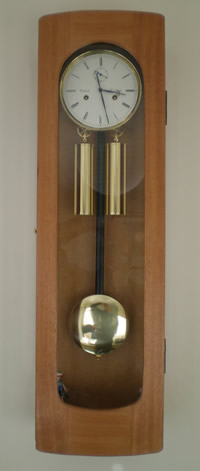
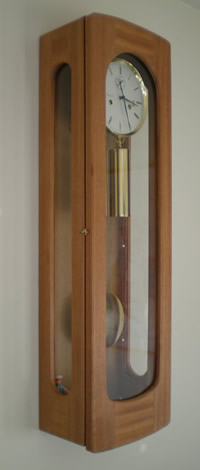
A wall clock in salvaged ship yard Mahogany
Phil Smith - Bradford on Avon - England.
Hello again Frank
I designed this clock using a rudimentary CAD package and I incorporated ideas on proportion and techniques from my first clock which was constructed using (mostly) one of your sets of plans.
It is fitted with a PS 055 Vienna movement set with a 65cm pendulum.
The case is made from rejected mahogany from a boat restorer and I´m quite pleased with the slimline look. The case is 970mm high by 280mm wide and very heavy. I was surprised by the weight of the 4mm thick glass. The finish is water based satin varnish.
The case would take a 72cm pendulum which appeals to me as I like the slower tick-tocks.
The chime is deep and sonorous which I guess is due to the longer case favouring longer wavelength standing waves. Yes I was once upon a time a physics teacher!
Best regards,
Phil Smith,
Bradford on Avon
Phil Smith
|
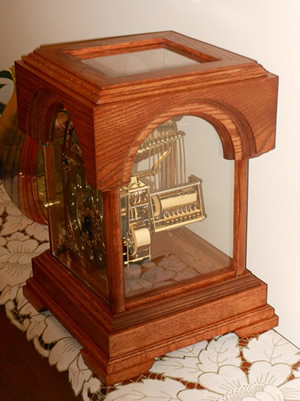
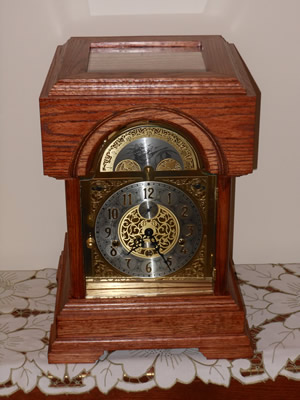
The Grandfather Head Table Clock
Karl Stone - Medina - Ohio - USA
The movement of this clock is the Kieninger REC004, nine-bell Mozart Limited Edition. Two of the chime melodies are Mozart, and the third is Westminster.
The dial is the Kieninger 200 x 275 mm Special Calendar Dial (moon and date) with brass Roman numerals on a silver chapter ring and a subsidiary seconds dial.
Chime melody selection and strike silencing is performed with two rotary levers on the front of the dial.
The dimensions of the case are 17.5”(h) x 12.5”(w) x 12.5”(d). The case is red oak stained red chestnut. The glass door is 1/4" thick, while the sides and top are 3/32” thick. The hardest part of the assembly for me was installation of the glass in confined quarters. In a second build of this clock, I would make the top glass frame easily removable from the rest of the case for easier regulation and access to the movement. Still, a special bent-coat-hanger tool allows adjusting speed without removing the movement, but you have to bend it just right!
Karl Stone
|
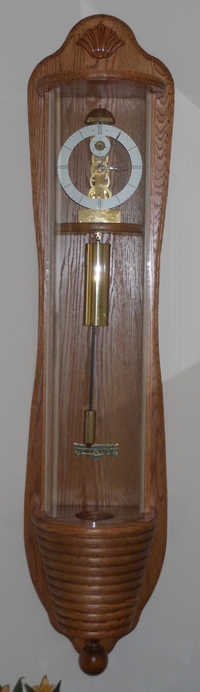
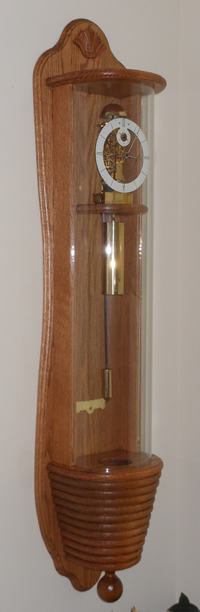
The Beehive Wall Clock
Karl Stone - Medina - Ohio - USA
One Curvaceous Wall Clock
Karl Stone Medina, Ohio, USA
As the name explicitly states, this is one curvaceous wall clock! I just about always show folks my mistakes, because I relish getting myself out of problems of my own creation. Well, this clock is one big mistake!
When I ordered the Kieninger TS-002 movement (65 cm pendulum), I assumed that, in changing the pendulum length from 116 to 65 cm, Kieninger had re-proportioned (shortened) the drive weight drop to approximate the shorter pendulum length. So I threw in a few extra inches, over the pendulum length, for the weight drop and specified a 33” tall curved display glass. Wrong!! It turns out that the drive weight drop is a full 14” longer than the pendulum length. So, I decided to employ a fix, a version of which I proudly displayed on an earlier “arched floor clock” lower on this page. That fix was a pendulum well, as I needed to add 2” for a pendulum that turned out to be longer than I planned. The current fix is a weight well, which is a prominent feature of this curvy clock.
The weight well is 3” in diameter to accommodate the 2”-diameter weight. Once I decided that the weight well would be circular to match the curved display glass, it was easy to decide that I would use (abuse?) circular curves everywhere else.
The wall clock stands 53”(h) x 12”(w) x 8”(d). It is red oak stained medium golden oak. For better or worse, you’ll never see another clock like this one!
Karl Stone
|
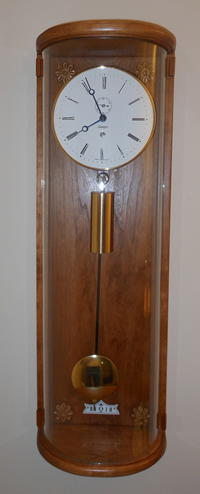
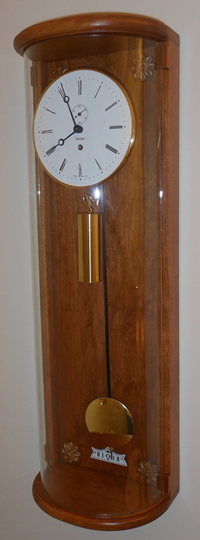
Curved-Glass Wall Clock
Karl Stone - Medina - Ohio - USA
The movement in this wall clock is the Kieninger NS003 precision miniature weight-driven movement. It has several ruby bushings and adjustable escapement pallets—quite impressive at such a small size. This movement, along with the carbon-fiber-rod pendulum, should be quite accurate: We’ll see with time! The wood is cherry stained light walnut.
The dimensions of the case are 25”(h) x 8”(w) x 5”(d). The hardest part about making this clock is finding a glass bender who will supply the tight 3-1/2” radius bend in the 1/8”-thick glass. It seems that the glass suppliers are afraid of optical distortions at tight radii. I finally found a bender in Vancouver, BC, Canada who did the bending confidently and beautifully.
Karl Stone
|
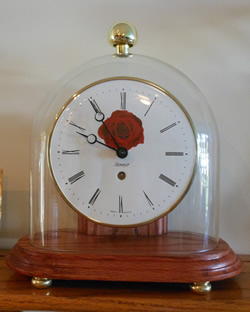
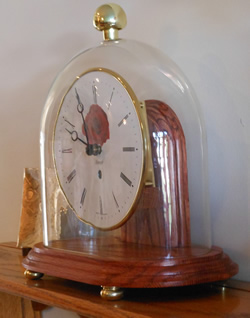
Glass Dome Rose Mantel Clock
Karl Stone - Medina - Ohio - USA
This clock is more a crafter’s delight than it is a clock cabinetmaker’s pride and joy! However, the end result of this beautiful, little craft project is a seriously accurate mantel clock with a miniature spring-driven movement.
The clock is 10-1/2”(h) x 10”(w) x 6”(d). The glass dome, which is supplied off the shelf from a home decorators’ supply, is 8”(h) x 8”(w) x 4”(d).
The movement is the Kieninger NE004 miniature, featuring a full-jewel Swiss chronometer escapement—very accurate. The dial is intended for the NS003, which is the weight-driven cousin of the NE004. So, the dial required two modifications: First, I epoxied in/across the seconds-hole and smoothed it over with fine abrasive. Two layered, semi-transparent rose appliques cover up the seconds-time-ring beautifully. Second, the keyhole needed to be drilled out for a 4 mm key, since the NS003 is 3 mm, while the NE004 is 4 mm.
The brass knob on top is a standard drawer pull epoxied to the glass, and the brass bun feet come from a small-furniture supplier.
The only parts left to be made of wood are the base and a mounting bracket: The wood is red oak stained red. Centering the 6”-diameter dial and positioning the fully assembled thickness within the constraints of the dome were challenges, but it all came out right, first time, just as the paper layout said it should!
Karl Stone
|
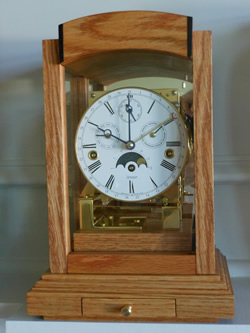
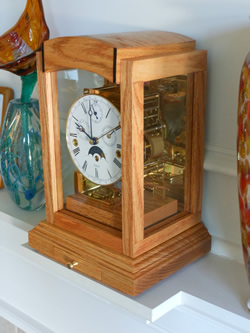
A table clock fitted with the Kieninger J0221C movement and multifunction dial.
Karl Stone - Medina - Ohio - USA
The obvious highlight of this clock is the Kieninger J0221C movement with its beautiful multifunction dial, including seconds, date, day, month, and lunar calendar.
The three separate chimes are fast, soft and unique in sound. The spring power goes through a fully jeweled Swiss chronometer escapement: It’s as accurate as a spring-driven movement comes. Nothing left to do but display the movement prominently in a simple case!
The wood is red oak stained light orange-brown. The one-piece top lifts off and has 3 panes of glass and a back mirror, all 3/32” thick. The dimensions of the case are 12”(h) x 8-1/2”(w) x 7”(d). The frame pieces are 3/4” x 3/4”, making the mortise-and-tenon joints, as well as staining/finishing (with glass), a bit of a challenge.
It is not as slick as the Kieninger clock it is modelled after, but it’s all mine!
Karl Stone
|
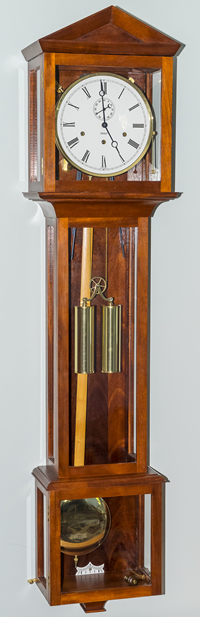
A Large Laterndluhr Vienna Regulator with Westminster chimes.
Donald Wyllie - Bedford - Canada
Large Laterndluhr Regulator fitted with a Kieninger seconds beating RWS - 116cm movement and accessories from Oakside´s Set 29. The case is Honduran mahogany and based loosely on the design in Greville´s catalogue. The top and bottom doors are hinged while the middle door is lift and remove. The back is birch ply with Honduran veneer inside and out. I cheated and used vacuum bagging rather than animal glue as I should. All the mouldings are home made. It is finished in shellac and wax to give it a used look.
Donald Wyllie
|
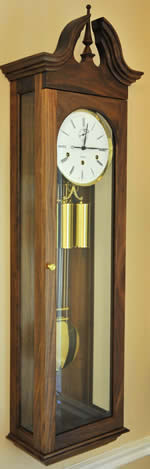
Vienna Regulator, designed and built by Bob
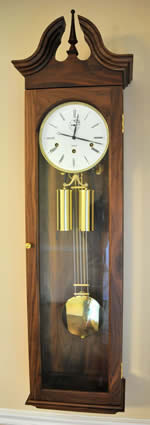
Robert Gilmore - Anaheim - California - USA
Frank -
Attached are some jpg´s of one of the two nearly identical wall clocks I made to house the RWS movements you provided. The wood is all walnut with the back and top panels of walnut faced plywood. Glass is all beveled and tempered. The case is 48 inches tall, 8 -1/4 inches deep (back to front of arch moldings) and 13-3/8" across the top moldings.
Thanks for all your help. Bob Gilmore
Bob Gilmore
|
Modern styly floor clock in Jarrah and Curly Jarrah
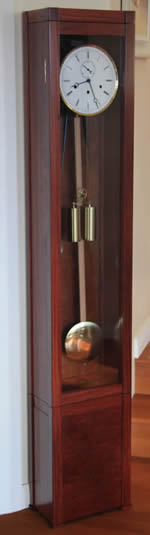
Gerald Hutton - Yallingup - Perth - Western Australia
Hi Frank,
Firstly thanks for your help on this clock. It is made from one plank of Jarrah (Swan River mahogany) which was milled about 20 years ago, so it is all one bit of wood.
The feature panel is Curly Jarrah. The finish is 4 coats of wipe on poly satin. I would have liked to have had the cut out face that I originally wanted as it would show the brass work better on the mechanism. If I make another, and I probably will, I will use glass on the side as well. I didn´t do it because I thought that it would be too narrow.
I originally set the mechanism up on a board and hung it which enabled me to sort everything while I could get at it. The alignment of the chimes took a bit of work and when I moved it to the clock case I found that the screw on one side caught the chime rod, so I moved it up about 20mm, which solved the problem and made the chimes more melodious.
I am very pleased with the results, cheers
Gerald
Gerald Hutton
|
Table clock in Cherry with Ebony accents.
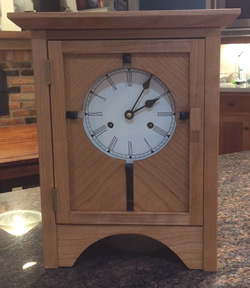
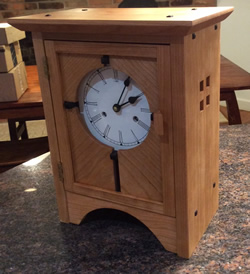
Marta Lively - West Windsor - New Jersey - USA
Info to follow
Marta Lively
|
Wall Clock in Oak by Rob Cheetham
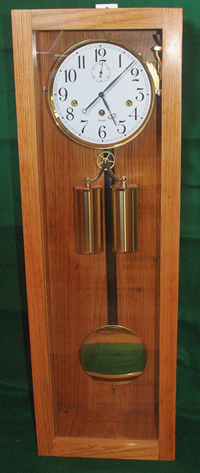
Rob Cheetham - Kenilworth - Warwickshire - England
Frank,
I have completed the clock. Attached are three photos.
It has taken a bit of time to adjust the gongs. Also the night off setting was 3 1/2 hours out & so it took a bit of working out how to get it correct. This is now done.
Case construction was from a single plank of oak - 22mm thick.
I used a circular saw, a crosscut saw & hand drill, hence the ´rustic´ construction.
I glued the pieces of oak together with wooden dowels.
I used 6mm strip wood to fit the 2mm glass to the sides, using screws.
The Oak was finished with 4 coats of Bestwood Danish oil and then a few coats of Mylands wax polish.
.A couple of points for novice clock making customers;
a) advise them to read the Kieninger instruction manual on the Oaksider web site before ´starting´ the clock.
b) advise them of the adjustment proccedure for setting the hammers so that they alloign correctly with the gong rods.
c) set up the movement on a dummy back board to establish the exact clock case dimerntional requirements and to make adjustments to the gongs prior to fitting into the finish cabinet.
Thanks for your help.
The clock is going nicely on the wall - looking exactly as I had planned & imagined it.
Regards,
Rob.
Rob Cheetham
|
Wall Clock in Ash by Graham Smith
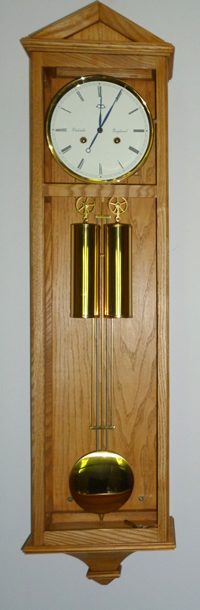
Graham Smith - Alresford - Hampshire - England
Prior to making this clock I had made various others including couple of bracket clocks, a Venetian wall clock and a Grandmother clock, the latter two being specifically dedicated to close relatives.
About 20 years ago I planned to make a more contemporary wall clock and obtained a drawing and the necessary ash wood but somehow or another never got around to making it.
Over the years I re-visited the drawing and the prepared wood several times but never made a start on the cabinet construction.
During recent months there had been a lot of events national and international events commemorating those who had served in the last two world wars.
As my Grandfather had been killed in the Battle of the Somme in 1916 it seemed appropriate to have something dedicated to him which could be passed down through the generations.
I therefore contacted Frank and asked for advice about a movement which would fit the drawing. It turned out there was only one LRS movement which fitted the cabinet and so I ordered it and with Frank’s on going advice built the cabinet and fitted the movement.
Graham Smith
|
Grandfather Clock designed and built in Walnut by Bob
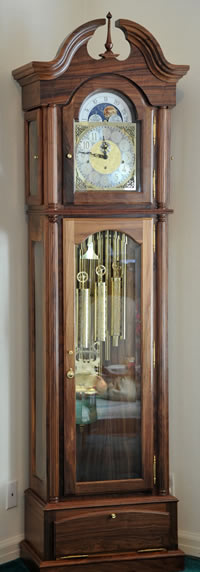
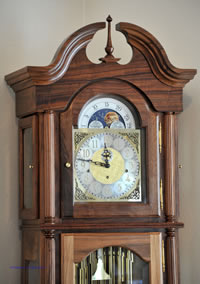
Bob Gilmore - Anaheim - California - USA
The construction is all Walnut with a clear satin polyurethane finish.
The design is based on a several clocks I´ve seen on line and modified to my own taste. Fitted with the Kieninger HTU Set supplied by Frank at Oakside Classic Clocks - England.
Not quite satisfied with the look of the finial, so when I finish my current wall clock build, I expect to turn an improved version.
Thanks for all your help - Bob G
Bob Gilmore
|
Large Laterndluhr wall clock in red Oak.
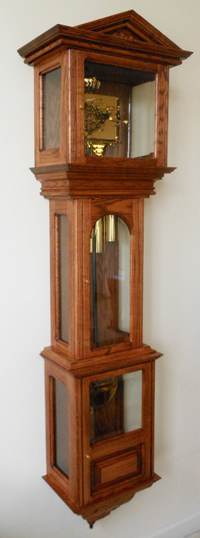
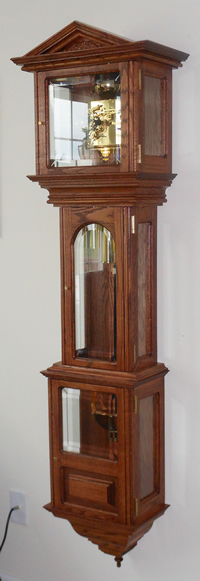
Karl Stone - Medina - Ohio - USA
Laterndluhr
Movement: Set 32 RSB 5-Bell Movement
Dial: 089 Kieninger 203 mm Special Multifunction Dial
Pendulum: 116 Special Carbon Fiber Pendulum with Fine-Adjust Bob
Wood: Red Oak
Color: Walnut
Dimensions: 69” (h) x 19” (w) x 11” (d)
Glass: 9 Panes; Front 3 Beveled 3/16” (t)
This is, by far, the largest wall clock I have made, but I couldn’t pass up the opportunity to build a very accurate Kieninger-movement wall clock. I’m looking for 1-2 seconds per week accuracy, and this movement-pendulum combination should get me there. I have collected 12 antique clocks, 6 of which are Alt Deutsch style Vienna Regulators. Being partial to Vienna Regulators, I was drawn to the early Laterndluhr style and Frank’s comment on the website that the RSB is a good choice for that.
Karl Stone
|
Arched Floor Clock constructed in red Oak
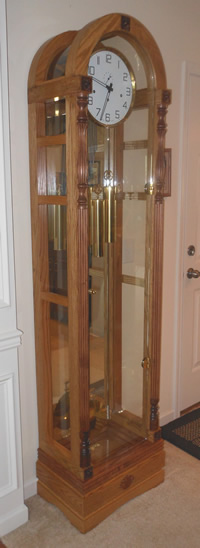
Karl Stone - Medina - Ohio - USA
Arched Floor Clock
Movement: HSU01 Movement Modified for 48-BPM Long Pendulum
Dial: 099 Oakside Dial and Hands
Pendulum: Extra-Long Carbon Fiber Pendulum and Oakside Fine-Adjust Bob
Wood: Red Oak
Color: Honey and Walnut
Dimensions: 82” (h) x 21” (w) x 14” (d)
Glass: 3/16” (t) Sides and Back Mirror; Two, 3/16” (t) Half Arches on Top; 1/4” Safety Glass Door Drilled for 2 Brass Hinges and Knob
This is one big, heavy project! All the beams are 2-1/4” x 2-1/4” laminates of three thicknesses of 3/4” planed lumber. The exposed laminated edges are all veneered, and this was my first attempt at veneer work. The two top arch beams are made from 12 quarter-circle pieces laminated and veneered. The finish is two-toned, honey with walnut accents. This 48-BPM HSU01 will be my most accurate clock. Thanks, Frank, for supplying the needed modifications!
Karl Stone
|
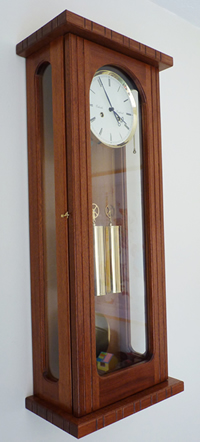
Excelent ´first clock build´ in reclaimed Mahogany.
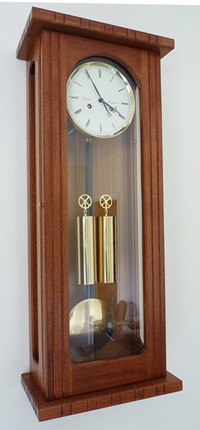
Phil Smith - Bradford on Avon - Wiltshire - England
Hello Frank
This is my first attempt at precision cabinet making let alone making a clock case! I´ve really enjoyed doing it and will be coming back to you for another mechanism and face set.
My clock was designed to accomodate Set 11 from your web page using the LSR 02 movement. The case is made from reclaimed Mahogany and is 850mm high by 350 wide by 195 deep. It has a satin varnish finish. The pendulum has a pleasingly slow movement compared to a 100 year old wall clock I´ve had for 35 years.
The clock is to go to my elder son but only when I´ve made another one.
I´ve learned a lot and made many mistakes.
One thing I´ve learned is to be more selective with the starting timber. The mahogany was from an old staircase and about 35mm thick. To get this to a usable size was hard going with my tools which were more geared to kitchen and bathroom renewal!
Regards, Phil Smith.
Phil Smith
|
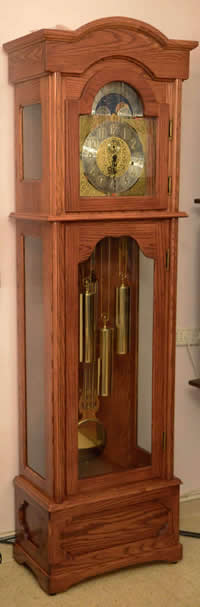
Superb Grandfather Clock with the Set 49 Kieninger KSU 55 Nine Bells movement.
Hanan Yinnon - Haifa -Israel
Dear Frank
My project is finally finished. Please see attached a picture of the completed clock.
I plan to document the construction dimensions, parameters and other related issues. Especially, I intend to document the metric dimensions I have used. If you like, I can share it with your website viewers. Please let me know if you are interested.
Best regards and thanks for your support throughout the entire project – it has been a wonderful experience for me.
Hanan
Hanan Yinnon
|
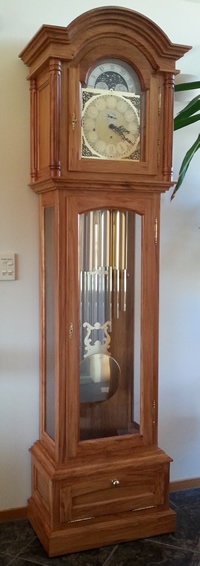
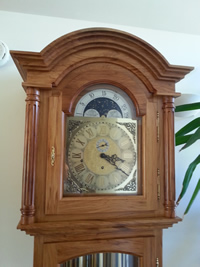
Dempsey´s design Grandfather clock by Terry Richardson with HTU 06 Movement
Terry Richardson - Christchurch - New Zealand
Frank,
As promised i attach pictures of my finished clock.
This incorporates the HTU movement which I am very happy with.
I used Heart Rimu (a rare native timber to New Zealand). My 30 year desire to build from this timber is now realised. I like the colour and grain, although it is difficult timber to work with. It is a hardwood – hard on tools, and has a tendancy to move from day to day and to split. For example, I bought the new kiln dried timber a year ago and it sat in my workshop for 9 months. By this time half of it was unusable due to warpage. Getting things straight and square was a challenge (among the many). The cabinet took 3 1/2 months to build (a good winter project given the sun reaches the workshop at 10.30 to 11 am)
I mainly used the plan by Pieter Van Vliet which was accurate and comprehensive. There was no way i could complete the project without this guidance. I am very grateful to him for the guidance of the plan. Like some others I made the hood roof from laminated Ply veneered in Rimu. It is finished with satin polyurethane.
I really want to thank you for your help and advice in the early stages of construction.
I would particularly like Pieter to know how grateful i am for his excellent plan, but unfortunately i cannot find his email address. I would be grateful if you could forward this to him or better – send me his email if acceptable so i can thank him myself.
I wish you all the best for your family and business. It has been a pleasure dealing with you and your company.
Kindest regards
Terry Richardson
Terry Richardson
|
Grandfather clock by Rob Wallace.
Bob Wallace - Romsey - Hants - England
Hi Frank
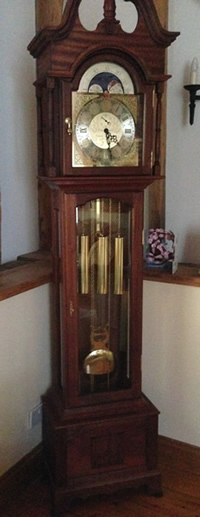
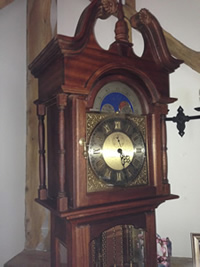
You mentioned some time ago that when clock was finished you would like some pictures of it, so here are a few, showing it in its new home. It was a pleasure to build, I altered a few things the main one being that the hood is fixed to the top and not removable as it is easy to remove the movement from the front if need be. The swan necks were made using carving software on my cnc mill.
Kind Regards
Bob
Bob Wallace
|
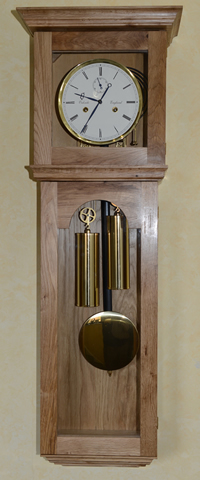
An excelent ´First Build´ Vienna Regulater by John Steward using Plan 016.
John Steward - Bishop´s Stortford - England
Hi Frank
Please find attached photo of my Vienna Regulator with a PS 055 Vienna movement. The case is the first that I have made and is from Oak. The finish is with fine sanding and polished with a bees wax, turpentine and linseed oil mixture. It is hanging in our lounge and looks very good. Time keeping is very good, it only needed slight adjustment. Also I must congratulate you on the way in which the movement and associated parts were packaged.
Many thanks for you help.
John Steward
|
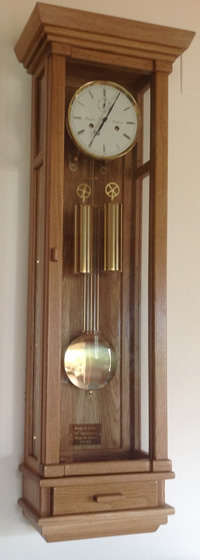
Fantastic ´First Build´ Vienna Regulator constructed by John Gilbert
John Gilburt - Alicante - Spain
Hi Frank,
Attached is the image of my completed clock, this is the first clock that I have constructed and would appreciate your professional opinion.
Constructed with North American white Oak, which came out a little darker than I first expected.
Fitted with the Oakside Set 12 featuring the Kieninger PS 055 Vienna movement.
The clock is now running perfectly having established the correct positions for the chiming lever.
Very pleased with the out come, only wish I,d gone for the RWS movement with the Westminster chime.
Thanks for your help and advice.
all the best
John
John Gilburt
|
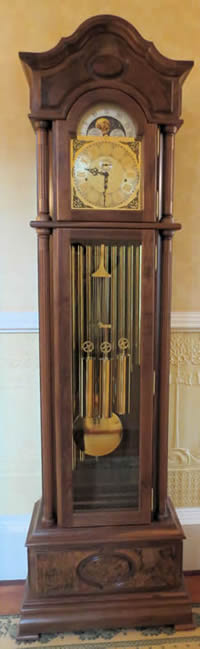
Superb Grandfather Clock with the HTU 06 movement and built by Allan Gough
Allan Gough - South Wales - UK
Dear Frank
The clock was crafted for my daughter and her family, to replace a similar clock that I made for them
10 years ago, which they subsequently shipped to their new home in California – keeping their home
In Scotland as a UK base for visits.
Due to the noticeable gap left by the removal of the clock, I undertook the construction of a replacement, albeit on a slightly larger scale.
The design of the clock was based on a photograph, and drawn up on a drawing board (i will have to learn cad, maybe tommorrow !!. It is 239cm (94”) tall, 74cm (29.1/4” wide and 40cm (15/3/4”) deep, using a Keininger HTU tubular movement. I made the main structure of American Walnut, the back and top of 8mm thick ply veneered both sides. The ‘planted’ decoration is faced with Burr Walnut. It was sprayed with water based varnish and waxed.
I trust the above will prove to be of interest to you and feel free to modify as you see fit. Photographs attached.
Yours sincerely
ALLAN R GOUGH
Allan Gough
|
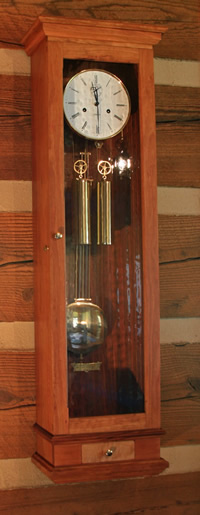
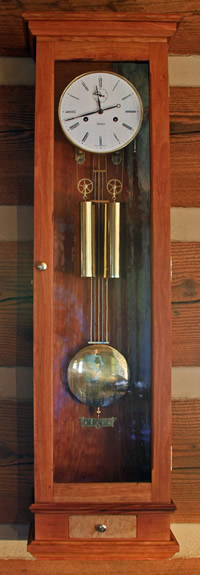
An excelent wall clock in Cherry by Patrick Ballard.
Patrick Ballard - North Carolina - USA
Hi Frank,
I recently finished the clock project using the clock I ordered from you a couple of months ago. I thought you might want some pictures for your website. The clock mechanism is the Kieninger PS 055 Vienna movement set. The case is cherry with a birdseye maple drawer front and reproduction antique glass.
Thanks,
Patrick
Leicester, North Carolina
Patrick Ballard
|
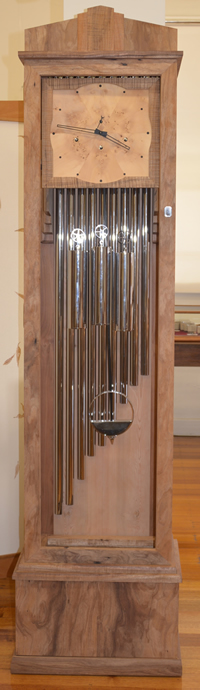
A superb floor clock in Tasmanian Blackwood
Trevor Jones - Tasmania
Frank
Pleased to provide information and an image of my newest creation. It is fitted with the Kieninger HTU 06 Tubular Bell Movement, Set 54.
It has been a long time coming, but is quite beautiful. I made it out of highly figured Tasmanian Blackwood with the face in Huon Pine and Ebony. The backboard is made of King William Pine which is a lovely, resonating musical timber.
I have not yet lacquered it nor fitted the glass, but it´s easier to taker a photo without glass, I think.
It is probably the most complex case I have made and is quite precise in the measurements to accommodate the large face and the tubes. I have tried to continue the art deco detailing throughout the fittings. I still need to put a small board on the sides of the movement to hide the brass works and to fit nickelled door hinges. That way everything will be bright nickel and chrome.
It has a few special features including a set of sturdy wheels at the back and adjustable feet at the front. The feet adjust from within the lower cabinet. There´s also a hinged lid on top to facilitate the fitting of the tubes from their hangers.
I´ll send another photo once I get time to finish it.
Regards,
Trevor Jones
|
Reproduction C 1780 Margetts Grandfather Clock by George Giles
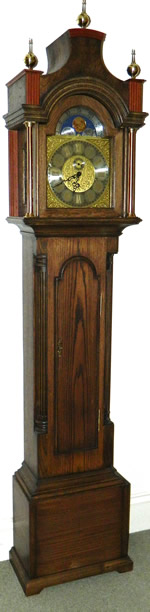
George Giles - Somerset - England
I first started to want to build a long case clock about twenty years ago, when visiting the depths of an antique shop in Chester, where the walls of several rooms were lined with clocks. My son in law heard about my intention and bought me an excellent book for my birthday, from which my wife spotted a 9ft tall pagoda topped clock made by Margetts circa 1780 and said why don’t you make one like that. Fortunately I found plans produced by a Peter Skilton that were published in the October 1988 issue of The Woodworker. The plans closely relate to the Margetts clock. It uses the Kieninger KSU 52 movement. The majority of the clock is made from oak with mahogany trimmings. It probably took about 2 years to make working when it was either cold. wet, or dark. The most fascinating part of the project was thinking up methods to produce some of the parts particularly the 16 piece pediment arch and the reeded columns
George Giles
|
Grandfather Clock by Winand Faßbender
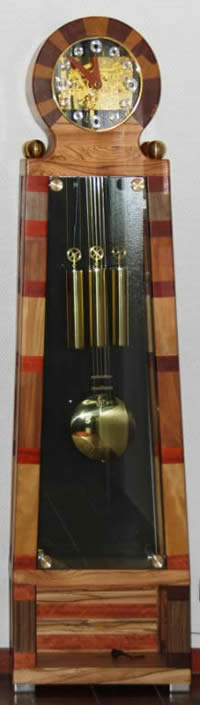
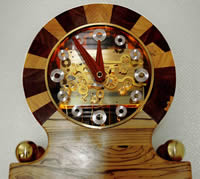
Winand Fassbender - Grevenroich - Germany
Grandfather Clock by Winand Faßbender
Winand Faßbender
|
Mantle Clock by Roger Antrobus
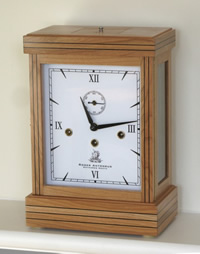
Roger Antrobus - Sussex - England
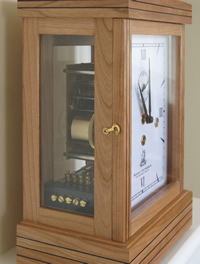
The mantel clock.
The movement is a Kieninger AEL04 with Westminster chime.
The case is made of Cherry wood with Ebony inlays and is a mere 295mm or 11.5" tall. The wood was finished with three coats of Danish Oil then 4 coats of wax.
The dial was designed on the computer using Photoshop, printed on archival paper then laminated in thick plastic.
The hands were self made by hand.
Roger Antrobus
|
Vienna Regulator Wall Clock by Roger Antrobus
Roger Antrobus - Sussex - England
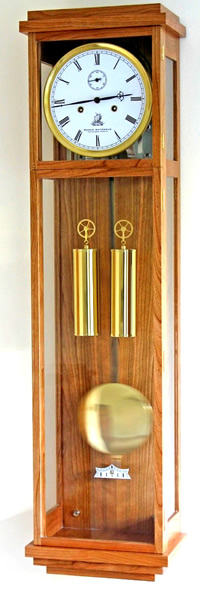
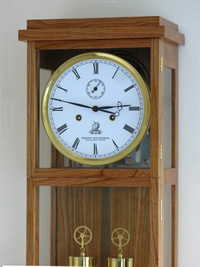
The Vienna
The movement is a Kieninger PS058 with Hour and half hour strike.
The case is made of Cherry wood and was finished with three coats of Danish Oil then 4 coats of wax.
The dial was designed on the computer using Photoshop, printed on archival paper then laminated in thick plastic.
Roger Antrobus
|
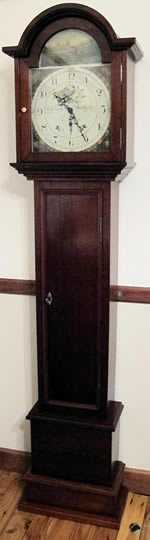
Grandfather Clock in reclaimed 19thC Australian cedar by John Clark.
John Clark - Wentworth Falls - Australia
Hi Frank, As promised, here´s a picture of the finished clock, constructed with reclaimed 19thC Australian cedar, comes up a bit like European Mahogany when french polished but perhaps a little darker. Wonderful wood that is now unobtainable.
Most of this clock started life as door frames, skirting boards and the like!
Thank you so much for your help, prompt answers to questions and the timely supply of an excellent clock movement. I´m not sure it would all have happened without you.
With my good wishes,
John
PS I trust your son settles happily in Perth, it´s a thriving city.
Professor JE Clark
John Clark
|
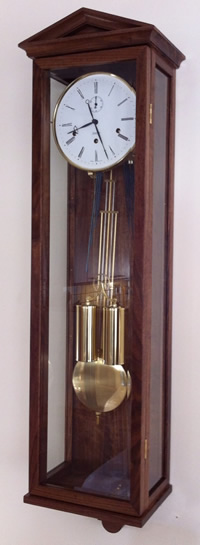
Vienna Regulator in Walnut by Paschalis Zaimis
Paschalis Zaimis - Kavala - Greece
This is the case I made of American walnut.
I bought Set 14 from Oakside Classic Clocks comprising the Kieninger RWS13 -65cm and the Vienna 20cm dial and following your dimensions for the case I have no problem for the installation.
Finally I decided to change the original Vienna hands with Breguet Hands because with the
Vienna we had a meeting every time to decide the time.
Once again I would like to thank you for your help and advices.
Paschalis
Paschalis Zaimis
|
Dempsey´s design Grandfather Clock with HTU 06 Movement
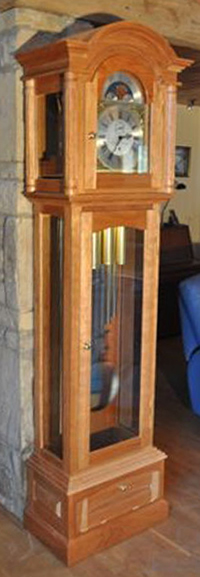
Chris Redfearn - Halifax - England
Chris Redfearn from Halifax in the north of England sent Pieter the following email.
I came across your site via Oakside Classic Clocks whilst researching where to buy a mechanism. I have harboured a desire to build a grandfather for more than 30 years but children, work and barn renovations have got in the way till this year. I was very impressed with the comprehensive detail you put on the site which enabled me to build the clock with relative ease. There are a few small differences but these are not substantial e.g my hood roof is made from several sheets of kerf-cut cherry-faced MDF laminated into the required curve. As you can see from the pictures I used cherry which I have not worked with before, but the result is pleasing and the clock is a great addition to our house. I know from talking to Frank at Oakside (where I bought the mechanism) that he wished me to send you some pictures of the finished clock and I had in any case intended to do so because your site is a great resource.
In my reply to Chris I said, "Your grandfather clock looks great and looks like a carbon copy of mine, which is of course not surprising as you used my drawings. I have never used cherry, but your clock has a nice warm look." Chris also allowed me to publish pictures of his perfect looking grandfather clock. Thanks Chris.
Chris Redfearn
|
New England Windsor style floor clock by Douglas Kuntze
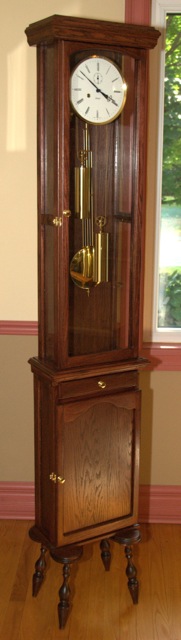
Douglas Kuntze - Ottawa - Canada
Hi Frank -- I bought a Kieninger PS055 kit from Oakside in 2009. This clock is similar to two wall clocks I made several years ago -- all are based on a photo of a 1905 regulator I found on the internet. The cases are made of oak. The upper clock case sits inside the lower cabinet and provides the inside frame for the drawer (key storage). The idea for the legs (they are maple Windsor chair seat-to-arm stiles, I don´t have a lathe) came from our dining room furniture (New England Windsor-style table and chairs). Each leg is independently mounted in a maple "wheel" (cut with a hole saw and angle-drilled in a simple drill press jig) which, in turn, is mounted to the oak base. Accordingly, the tops of the legs don´t show through. The finish is Minwax red mahogany stain and satin varnish. The lower case/cabinet was designed to house my Islay single malt scotch!
Douglas Kuntze
|
Arts and Crafts wall clock by David Moore
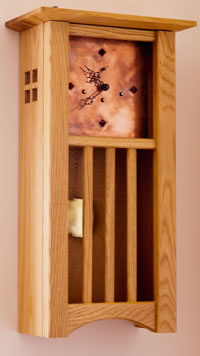
David Moore - Birmingham - England
Arts and Crafts Wall Clock built by myself from Plan 021 and incorporating Set 10a from the Oakside range.
I constructed this clock from White Oak, and modified the original drawing to match the style of the other furniture.
The face is brass sheet, cleaned with 0000 wire wool then I used a blacking agent that I use to back lead on stain glass windows. I drilled the hole with a brad point drill, normal twist drills tend to drill egg shaped holes in thin sheet.
The buttons on the face were made form Purple Heart shaped on a shooting board then glued to the face with Araldite.
David Moore
|
Large Wall Clock by Trevor Jones
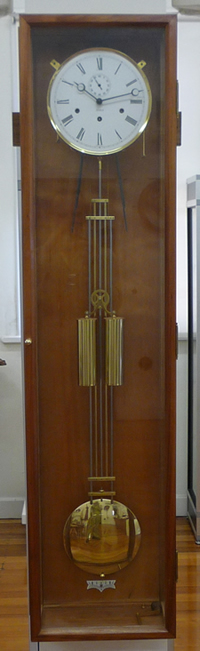
Trevor Jones - Tasmania
Large Wall Clock designed by myself and built in Tasmanian Blackwood with the backboard in King William Pine.
The clock incorporates the Oakside Set 29, Kieninger RWS 39 movement and with the Kieninger Temperature Compensating Pendulum.
Trevor Jones
|
Grandfather clock by Bruce Peterson
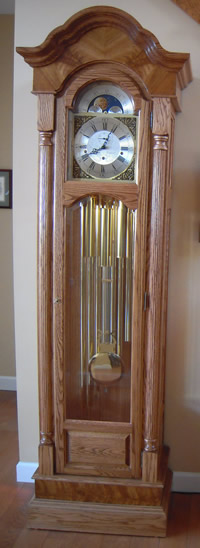
Bruce Peterson - Moline - Illinois - USA
A fine Columbia style grandfather clock from a kit purchased from a U.S. clockmaker supplier.
For this clock I selected the very finest mechanical movement available - the Kieninger HTU 06 with 9 brass chime tubes - this was purchased as a comprehensive Set from Oakside Classic Clocks. I also used the Oakside 070 Special Reproduction Silver Plated Moon Phase Dial which greatly compliments the case and chimes. I placed a back light at the top of the movement which allows for the beautiful pendulum and chime tubes to be viewed and accents the true beauty of the entire clock.
Thanks Oakside for helping me create another heirloom.
Bruce Peterson
Bruce Peterson
|
A large Mantle Clock by David Parsnick.
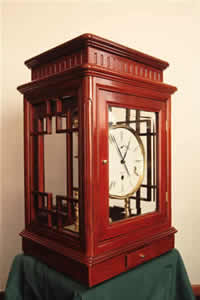
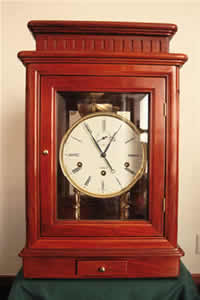
David Parsnick - Amherst - New York - USA
This project was started about March 2010 and completed in December 2010. The case material is made from solid Rosewood, imported from Thailand. Overall dimensions: 490mm (h) x 340 mm (w) x 300 mm (d). The movement is a Kieninger RWU-03 supplied by Frank at Oakside, it plays Whittington, St. Michael, and Westminster on a cluster of nine brass bells. The movement is mounted on a custom made, machined brass pedestal.
David Parsnick
|
Grandfather clock by Sean McGarry
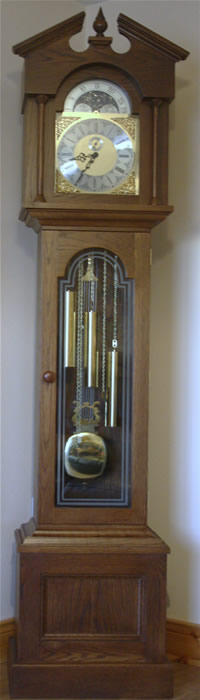
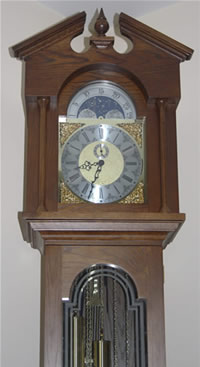
Sean McGarry - Portglenone - Co.Antrim - Northern Ireland
From an early age I have always loved working with wood making all types of items as a hobby. Most recently I have developed a passion for Grandfather clocks. I decided to make a clock some years ago and have not had the opportunity to make anymore since.
Now that most of my family have moved on and settled down I wanted to make them something that they could look back on and remind them of me in years to come. 3 clocks later they all have their new time pieces in their family homes.
Each of the clocks were made from white Oak, with some of them stained and some natural. I kept the same design for all 3 clocks, and the movements were Kieninger SK 012.
I want to thank Frank at Oakside Classic Clocks for his patience, advice and helpfulness whilst building the clocks.
Sean McGarry
|
Grandfather clock by John Myerscough
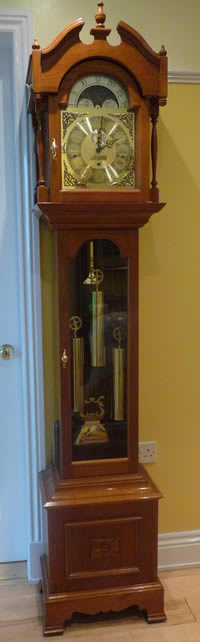
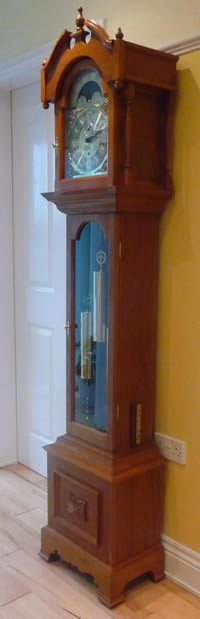
John Myerscough - Liverpool - England
Built during 2007 By John Myerscough.
This clock was built to my own design and constructed using Burmese Teak which was salvaged and recycled from the LEVER BROS, Port Sunlight,( Sunlight Soap ) laboratory when the factory was being demolished.
Brief History of Lever Brothers
Starting with a small grocery business begun by his father, William Lever and his brothers entered the soap business in 1885 by buying a small soap works in Warrington. Using glycerine and vegetable oils such as palm oil, rather than tallow, to manufacture soap, they produced a good, free-lathering soap, called Sunlight Soap, at a rate of 450 tons per week by 1888. Larger premises were built on marshes at Bromborough Pool on the Wirral Peninsula at what became Port Sunlight.
John Myerscough
|
Wall Clock by Paul Bailey
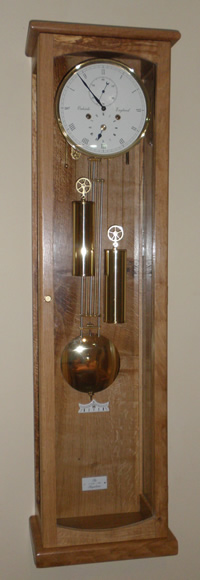
Paul Bailey - Egremont - Cumbria - England
Wall Clock was designed by me but constructed by my friend Steve Parkinson.
The case is made from Oak grown in Cumbria supplied by a local furniture maker Barry Porter, so local to me. The movement is a Kieninger PS 50. The case took about 40 hours to make. I´ve called it The 54 degrees North ~ 3 degrees West Regulator which are the longitude and latitude of the area in West Cumbria where it was made.
Thanks
Paul Bailey
|
Wall clocks by Bruce Peterson
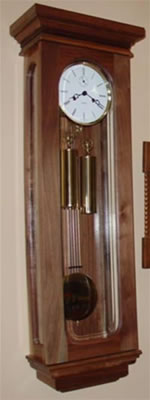
Bruce Peterson - Moline - Illinois - USA
I want to pass on to each of my children an heirloom and I believe that hand made mechanical clocks is a good way to do that.
The Walnut wood came from a tree their grandfather planted in the 1930s on the site of our home here in Illinois, USA.
We planed the wood to 3/4 inch (2cm) thickness and used a plan from an U.S. clock parts supplier. I felt that the heirloom would have more sentimental value if I kept the case simple; without knobs and clutter. The walnut wood and its origin were my highest priority, with a beautiful clock and movement that complimented the case. I wanted the night shut-off feature and a movement that would be of the highest quality, the Kieninger PS 037 was a perfect solution. With the help and guidance from Oakside Classic Clocks, I found the best match for my cases.
Thank you Oakside!!
Bruce Peterson
|
Wall & Floor regulators created by Martin Burgoyne
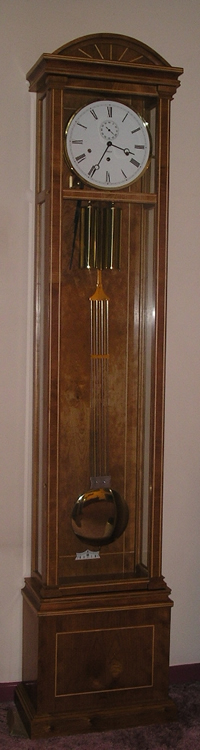
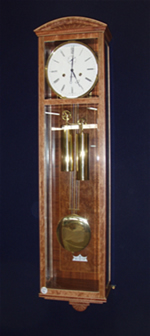
Martin Burgoyne - Jarrahdale - Western Australia
Floor standing Dachluhr with the Kieninger RWS movement, a 240mm dial and a compensated pendulum.
The case frames and door are made from solid American Cherry, with Cherry cross banding and maple stringing on the outside faces. The base and back panel are plywood veneered with Vavona with maple stringing. Having made a traditional grandfather clock, for my sister, my sister in law saw it and wanted one, but something a bit different. The classic Vienna Regulator floor standing design in a light coloured wood and with all that glass was what appealed to her. This clock was my first real go at veneering, cross banding and stringing. I used an iron-on glue film for the veneering, rather than and vacuum bag.
5 light Dachluhr
This uses Kieninger´s PS movement with 200 mm dial and gridiron compensated pendulum. A commission for some Australian friends who wanted a wall clock but something light and simple. The case is made from solid Jarrah, a local timber the export of which helped to found the new colony of Western Australia in the 1850s, it was often called Swan River mahogany. The frames and doors use a solid flame version, with applied Tasmanian oak stringing. The back is veneered with Vavona, with straight grained Jarrah cross banding, and Tasmanian oak stringing. All frames have 3mm bevelled glass - these were hand machined as the width and thickness was too small to fit on a normal bevelling machine!! The clock won 1st place in the Miscellaneous class at the 2010 Out of the Woods Fine Woodworking Exhibition in Western Australia.
Martin Burgoyne
|
Ian Crawford´s version of a Tom Kealy design
Ian Crawford - Essex - England.
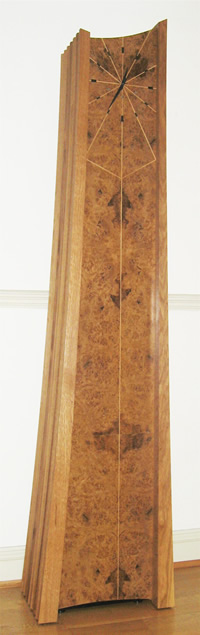
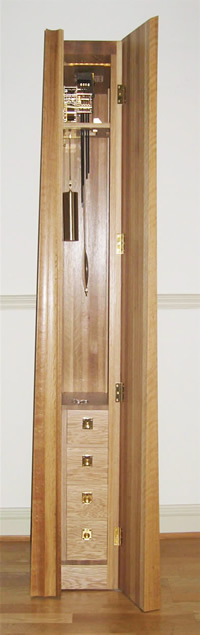
I first saw this clock in a furniture magazine, it was designed and made by Tom Kealy a contemporary furniture maker from Somerset. I subsequently saw the original at a furniture exhibition and was captivated by the elegance of the design and the quality of construction. It inspired me to make a copy for myself. I am a retired automobile design engineer having taken up woodworking on my retirement 10 years ago so this represented quite a challenge for me. I used Tom Kealy´s design albeit a little smaller and less curvy, but my own method of construction. It is made from American white oak with a burr oak veneered face incorporating ebony insets for the numeral markers. The finish is 3 coats of Danish oil and a final wax coat. I couldn´t find anyone who made contemporary hands so I made my own from American black walnut stained ebony and stuck to the original (slightly modified) traditional hands. Having researched mechanical clock mechanisms, I finally settled on the fine quality Kieninger RWS13 movement, incorporating an 8 rod gong Westminster Chime. I built a strip of LED´s into the top of the clock which are automatically switched on when the side door is opened to illuminate and highlight the magnificently engineered movement. I didn´t keep an accurate record of the construction time but I estimate it to be approximately 300 hours over 8 weeks, much of that time was spent constructing patterns and jigs and thinking how on earth to make it. It has probably been my most difficult project but also my most rewarding.
Ian Crawford
|
Dempsey´s Grandfather Clock with HTU 06 Movement
Pieter van Vliet - Calgary - Alberta - Canada
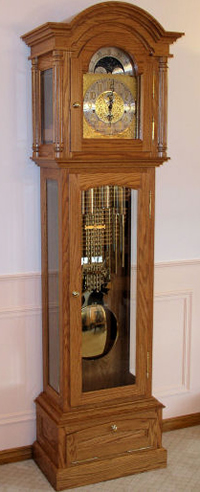
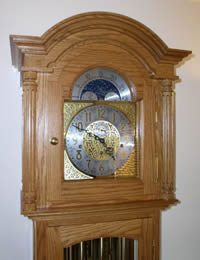
I am retired and a serious hobby woodworker during the long winter months in Western Canada. From an early age I admired and wanted to have a grandfather clock. Finally in the winter of 2009/2010 I decided that I had the skills to design and build my own grandfather clock. Research into what movement to use resulted in the selection of the 8-day Kieninger HTU 06 cable movement with Triple Chimes on 9 Tubular Bells. With an Arabic Moon Dial and a Lyre pendulum with 10½" diameter polished brass bob with a 14" swing I was set to begin the clock design.
I decided that the Winchester Grandfather Clock of Oakside Classic Clocks was the style I wanted. So I "borrowed" the large Winchester image from Oakside and, with the Kieninger HTU 06 movement as a given, I designed the clock and drew the 2-dimensional and 3-dimentional plans to build my own grandfather clock. As the drawing tool I used DesignCAD 3D MAX v20.0.
The case is built from solid red oak, stained in medium oak, and coated with three coats of Clear Satin Acrylic Urethane Varnish. The hood is removable. The waist and hood features bevelled glass on the sides. The dimensions of the grandfather clock are: height 83¾", width 24¾", depth 14¼".
It took 205 hours to build the clock case. To see the detailed project description with drawings, material list, pictures, and "What went wrong", visit my web site.
Pieter van Vliet
|
Web site: http://www.van-vliet.org/dempseywoodworking/grandfatherclock.shtml |